Listen to this post

Seyfarth Construction associate Michael Wagner spoke on the topic of fair legal solutions to material cost escalation in the April 19th episode of The Morning Huddle podcast “Contractual Solutions to Cost Escalation.”

Specialty contractors are feeling deeply exposed as they produce estimates today with prices that may be completely irrelevant tomorrow. Owners, of course, want price certainty in a totally uncertain market. Companies caught on the wrong side of this issue are risking devastating losses, and some companies are considering bowing out of the market right now rather than gamble on what seems like losing odds. The podcast discussed how contracts can protect everyone involved in a construction project. Listen to the full podcast here.
Listen to this post

On May 3, Seyfarth attorneys Teddie Arnold and Anthony LaPlaca are presenting a 1-day session on Government Contract Compliance as part of the Federal Publications Seminars’ Training Academy in La Jolla, California. Seyfarth attorneys Joe Dyer, Stephanie Magnell, and Bret Marfut will also be presenting remotely.

A substantive compliance program can reduce the chances that someone in your company will engage in improper practices. And although a compliance program cannot absolutely insure against incurring criminal, civil, or administrative liability to the government, it can provide contractors an effective shield against the worst consequences of a federal fraud investigation. This course provides assistance to individuals and organizations in ensuring compliance with federal laws and regulations.

This panel will allow attendees to:

  • Gain insights and knowledge on the relevant statutory offenses and penalties, including the False Claims Act and False Statements statute
  • Develop an understanding of how to set up and audit your compliance programs
  • Develop an understanding of rules governing interactions between government and contractor personnel
  • Understand the compliance and meaning of numerous discrete topics, including defective pricing, time charging, contract claims, and the Buy American Act

Find more information and register on the Federal Publications Seminars website.

Seyfarth Construction partner Jim Newland spoke about construction project cost escalation and the remedies during and after negotiations have commenced in the March 31st Federal Publications Seminars Podcast “Cost Escalation in Construction Contracts.”

In construction, cost escalation is not an uncommon thing as the price of raw building materials fluctuate often.  More recently, prices have been increasingly volatile since the start of the pandemic due to swings in supply and demand as well as political posturing. Listen to the full podcast here.

CHALLENGE

The Port of Anchorage Intermodal Expansion Project was envisioned to be a $1 billion project that would replace outdated infrastructure at the Port of Alaska, but defective management, design, and construction derailed the Project. Seyfarth was tasked with prosecuting claims and recovering money spent by the Department of Transportation Maritime Administration (MARAD) for the defective design and construction work as well as the costs to remove and replace defective work. The task was complicated by the agreements between the Municipality of Anchorage and MARAD, which were memorialized in a 2003 Memorandum of Understanding (MOU) and a subsequent 2011 Memorandum of Agreement (MOA). While the MOU and MOA spelled out the respective duties of the parties, assigning, among other things, design and construction oversight and management to MARAD, the United States refused to acknowledge that these were binding contracts. Seyfarth attorneys were required to prove the existence of valid and binding contracts through motions practice, a 2-day mini-trial, and a 9-day bench trial. Seyfarth attorneys also had to develop a method for calculating the damages sustained by the Municipality of Anchorage for the defective work procured by MARAD, which was complicated by the number of individual task orders issued by MARAD for various components of the project.

The importance of this challenge cannot be overstated, as the Port of Alaska is a critical national seaport—90% of all goods for 85% of Alaska’s population crosses its docks as does fuel for the adjacent joint military base and the Ted Stevens International Airport. The Port also serves the nation as Alaska’s only Department of Defense-designated strategic seaport and deploys equipment and supplies internationally to and from five military installations in Alaska. It is one of only 23 strategic seaports nationwide.

SOLUTION

Seyfarth attorneys quickly developed a litigation strategy to establish the existence of binding and enforceable contracts between the Municipality of Anchorage and MARAD. Using contemporaneous records and admissions by MARAD and its contractors, Seyfarth attorneys proved to the court that both the MOU and MOA were valid contracts and binding on the United States. Seyfarth attorneys also proved that MARAD took responsibility for design and construction oversight and management under both the MOU and MOA and that MARAD was responsible for delivering to the Municipality of Anchorage a completed Port that was free of defects. Working with trusted experts, Seyfarth attorneys developed a method for quantifying the damages incurred by the Municipality of Anchorage using an impairment methodology that was ultimately adopted by the United States Court of Federal Claims.

RESULTS

After a lengthy trial and nearly eight years of litigation, Seyfarth attorneys secured a complete victory on behalf of the Municipality of Anchorage. The United States Court of Federal Claims entered a judgment on behalf of the Municipality of Anchorage and against the United States for more than $367.4 million, awarding every dollar sought by the Municipality of Anchorage at trial. The result is one of the largest monetary judgments ever entered against the United States.

The case is also likely to have major implications for how the United States manages its future infrastructure projects under the Infrastructure Investment and Jobs Act. The decision reinforces the fact that the United States can be held liable for the damages caused by its third-party designers and contractors. In the future, federal agencies will likely look to cooperative agreements and direct grants as means to limit the United States’ exposure for possible design and construction failures on major projects for state and local governments.

The case also reinforces the need for proper risk mitigation on major infrastructure projects through appropriate bonding and insurance requirements for design professionals and contractors. While nobody wants to anticipate a failed project, providing proper protection against the risk of failure is of paramount importance.

The Seyfarth team for this case included Jason Smith, Bennett Greenberg, Donald Featherstun, and Teddie Arnold.

Adam Lasky, co-chair of Seyfarth’s Government Contracts practice, and Scott Hecker, senior counsel in Seyfarth’s Labor & Employment practice, are presenting “Hot Labor & Employment Issues in Federal Contracting” at the Alliance Northwest Conference on March 10, 2022. The program will cover hot issues and recent regulatory developments on Service Contract Act, Davis-Bacon Act, Project Labor Agreements, minimum wage and vaccine mandates.

Alliance Northwest is the largest business-to-government conference in the Pacific Northwest. This event, hosted by Thurston Economic Development Council, features high-quality workshops and matchmaking sessions between small businesses, government agencies, and prime contractors.

Find more information and register for this virtual conference on the Alliance Northwest website.

Teddie Arnold and Stephanie Magnell spoke about government contractors protecting themselves from government fraud arguments in the February 25th Federal Publications Seminars Podcast “Avoiding Fraud in Federal Contract Claims.”
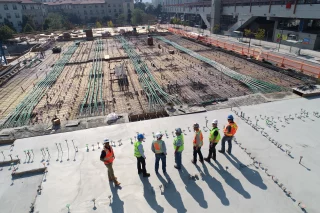
When contractors file claims against the government, they should make sure they are on solid ground to protect against government claims of fraud. Listen to the podcast here.

Jeff Hummel authored the “Risk Allocation: Design-Builder and Designer” chapter of the Design-Build, Public-Private Partnerships, and Collaboration Handbook. The comprehensive Handbook covers all aspects of the design-build delivery system, presents its pros and cons, and compares them with the traditional project delivery method. It also offers practical suggestions for effective drafting of design-build contracts, and sets out recent legal developments in various jurisdictions. Lastly, the Handbook addresses the increased use of collaboration among various parties, including through Public-Private Partnerships.

For more information about the Handbook, visit the Wolters Kluwer website.

James Newland is presenting a fourteen-part webinar series for Federal Publications Seminars. This fourteen-part webinar series is a deep dive into construction contracts, claims, and risk management as it presents and analyzes the risks that arise on construction projects, the contract clauses and drafting considerations in allocating those risks, and the claims and disputes methods and procedures used in documenting, presenting, mediating, arbitrating, or litigating the claims when they arise.  Along the way, the course presents and analyzes those topics from the perspective of the owner, general contractor and subcontractors operating on public or private construction projects. The topics are presented from both a legal and practical standpoint and the program discusses the substantive and administrative aspects of the key clauses, risks and claims prevalent on public and private construction projects.

See the full list of programs below, and register on the Federal Publications Seminars website. Continue Reading James Newland to Present Construction Contracts, Claims, and Risk Management Webinar Series

Seyfarth’s Construction team is pleased to announce the release of our 2022 edition of the 50 State Lien Law Notice Requirements Guide. The Guide provides the general time requirements for filing lien notices in each state, plus Washington, DC. Seyfarth’s Construction team prepared the survey for use by owners, commercial contractors, and real estate developers on non-public projects. Requirements may differ for residential and public projects. You can request a PDF of the 50 State Lien Law Notice Requirements Guide below.

REQUEST A COPY

The Fourth Circuit, in United States ex rel. Sheldon v. Allergan Sales, LLC, No. 20-2330, 2022 WL 211172 (4th Cir. Jan. 25, 2022) recently upheld the dismissal of False Claims Act (“FCA”) lawsuit brought by a quit tam relator (“Relator”) against his employer, Forest Laboratories, LLC (“Forest”) alleging that Forest engaged in a fraudulent price reporting scheme under the Medicaid Drug Rebate Statute (“Rebate Statute”).[1]

Notably, the Fourth Circuit adopted the US Supreme Court’s decision in Safeco Ins. Co. of Am. v. Burr, 551 U.S. 47 (2007) in holding that the scienter element of the FCA is subject to an “objective reasonableness” standard, where a defendant can defeat FCA liability by establishing that its interpretation of the applicable statute or regulation was objectively reasonable and that no authoritative guidance from a court or agency could have “warned defendant away” from that interpretation. Just last year, the Seventh Circuit adopted this standard in U.S. ex rel. Schutte v. SuperValu Inc., joining the Third, Eighth, Ninth, and DC Circuits in holding the same.

At issue in Sheldon was the reasonableness of Forest’s interpretation of the Rebate Statute in determining how it calculated certain discounts given to separate customers for purpose of reporting its “best price” to the government. The District Court dismissed the complaint on the basis that Forest’s reading of the Rebate Statute was “objectively reasonable,” there was no authoritative guidance to the contrary, and thus Forest did not act “knowingly” under the FCA. The Fourth Circuit affirmed.[2] Continue Reading Fourth Circuit Adopts Objective Reasonableness Standard in Determining Scienter Element of the False Claims Act